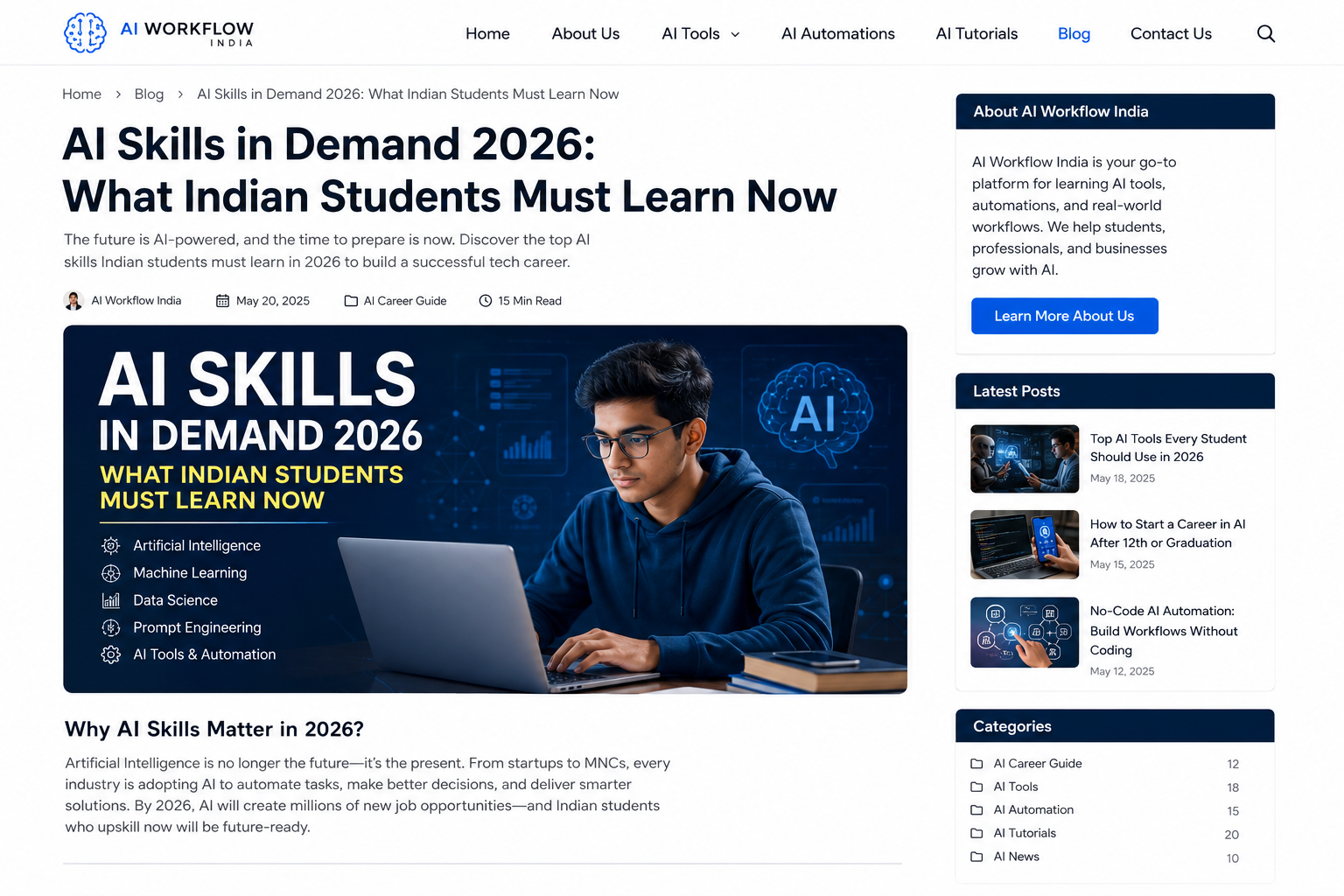
AI Skills in Demand 2026: What Indian Students Must Learn Now

Here’s a truth that might surprise you: by 2026, over 97 million new jobs will emerge globally due to artificial intelligence. And guess what? India is sitting right at the center of this revolution. If you’re a student wondering what skills will actually matter in the next few years, you’ve landed on the right page.
The AI skills in demand are changing faster than ever before. What worked five years ago won’t cut it anymore. Companies across India are desperately hunting for talent who understand machine learning, data science, and automation tools. But here’s the good news—you don’t need a PhD to get started. You just need the right roadmap.
Let’s break down exactly what AI skills 2026 will look like and how Indian students can prepare starting today.
Why AI Skills Matter More Than Ever for Indian Students
India’s tech industry is booming. From Bangalore to Hyderabad, startups and MNCs alike are investing heavily in artificial intelligence. The government’s push toward Digital India has opened doors that didn’t exist a decade ago.
But here’s the catch. There’s a massive skill gap. Companies have jobs, but they can’t find enough qualified people to fill them. A recent NASSCOM report showed that India will need over 1 million AI professionals by 2026. That’s a huge opportunity for students who start learning now.
Think about it this way. Learning future AI skills today is like learning to code in the early 2000s. Those who jumped in early built incredible careers. The same window is open right now for artificial intelligence.
Top AI Skills Students Should Focus on in 2026
So what exactly should you learn? Let’s get specific. These are the skills that hiring managers and tech leaders are actively looking for.
Machine Learning and Deep Learning
This is the foundation of everything AI-related. Machine learning allows computers to learn from data without being explicitly programmed. Deep learning takes it further with neural networks that mimic human brain function.
You don’t need to master everything overnight. Start with Python programming, then move to libraries like TensorFlow and PyTorch. Many free resources exist online to help you begin this journey.
Natural Language Processing (NLP)
Ever wondered how Alexa understands your voice or how ChatGPT writes like a human? That’s NLP in action. As more businesses adopt chatbots and voice assistants, professionals who understand language processing will be incredibly valuable.
Indian companies especially need NLP experts who can work with regional languages. This creates a unique opportunity that international candidates can’t easily fill.
Prompt Engineering
This is one of the hottest AI skills in demand right now. Prompt engineering involves writing effective instructions for AI systems like ChatGPT, DALL-E, and Midjourney. It sounds simple, but it requires understanding how these models think.
The best part? You can start practicing today without any coding knowledge. Experiment with different AI tools and learn what prompts produce the best results.
Data Science and Analytics
AI runs on data. Without clean, organized data, even the smartest algorithms fail. That’s why data science remains one of the most sought-after skills in the market.
Focus on learning SQL for database management, Python or R for analysis, and visualization tools like Tableau or Power BI. These skills complement AI knowledge perfectly.
Computer Vision
Self-driving cars, facial recognition, medical imaging—all powered by computer vision. This field teaches machines to interpret and understand visual information from the world.
For students interested in healthcare, automotive, or security industries, computer vision offers exciting career paths. It’s technically challenging but extremely rewarding.
How Indian Students Can Start Learning AI Today
Feeling overwhelmed? Don’t be. The path to mastering AI for students is clearer than you might think. Here’s a practical approach that works.
Build a Strong Foundation First
Before diving into complex algorithms, make sure your basics are solid. Focus on:
- Mathematics: Linear algebra, statistics, and probability
- Programming: Python is the most popular language for AI
- Problem-solving: Practice logical thinking through coding challenges
Many students skip these fundamentals and struggle later. Trust the process and build step by step.
Take Online Courses and Certifications
The internet has democratized education. Platforms like Coursera, edX, and NPTEL offer world-class AI courses, many of them free. Google and Microsoft also provide beginner-friendly certifications.
For Indian students specifically, resources at AI Workflow India provide localized guidance and practical learning paths designed for the Indian job market.
Work on Real Projects
Theory only takes you so far. Employers want to see what you’ve actually built. Start small with projects like:
- A sentiment analysis tool for movie reviews
- A chatbot that answers common questions
- An image classifier that recognizes different objects
Document everything on GitHub. This becomes your portfolio that speaks louder than any certificate.
Join AI Communities
Learning alone is hard. Find communities where you can ask questions, share progress, and stay motivated. Reddit’s machine learning forums, LinkedIn groups, and local meetups are great starting points.
India has a thriving AI community. Platforms like aiworkflowindia.com connect students with mentors, industry experts, and fellow learners who share similar goals.
Industries Hiring AI Talent in India
Wondering where these skills will actually take you? AI isn’t limited to tech companies anymore. Here are sectors actively hiring.
Healthcare
AI is transforming diagnostics, drug discovery, and patient care. Indian healthtech startups raised over $2 billion in recent years, and they need AI talent desperately.
Finance and Banking
Fraud detection, algorithmic trading, and customer service automation—banks are investing billions in AI. HDFC, ICICI, and SBI all have dedicated AI teams.
E-commerce and Retail
Recommendation engines, inventory management, and personalized marketing all rely on AI. Companies like Flipkart and Amazon India hire hundreds of AI engineers annually.
Manufacturing
Predictive maintenance and quality control powered by AI are revolutionizing Indian manufacturing. This sector often gets overlooked but offers stable, well-paying careers.
Common Mistakes to Avoid When Learning AI
I’ve seen many students make the same errors. Here’s what to watch out for:
- Chasing every new tool: Focus on fundamentals rather than jumping to every trending technology
- Ignoring soft skills: Communication and teamwork matter just as much as technical ability
- Not practicing enough: Reading tutorials isn’t enough; you must write code daily
- Waiting for the “perfect time”: Start now with whatever resources you have
The students who succeed are those who stay consistent, not those who start with the most advantages.
The Future Looks Bright for AI Learners in India
India stands at a unique crossroads. We have the population, the educational infrastructure, and the growing tech ecosystem to become a global AI powerhouse. What’s missing is enough skilled professionals to fill the gap.
That gap is your opportunity. The future AI skills you develop today will define your career for decades. Whether you’re in school, college, or early in your career, the time to start is now.
Don’t wait for the perfect course or the perfect mentor. Begin with what you have. Watch YouTube tutorials, complete free courses, build small projects, and most importantly—stay curious.
The AI revolution isn’t coming. It’s already here. The question is: will you be ready to ride the wave or watch others catch it? Visit AI Workflow India to explore structured learning paths and start your journey into the world of artificial intelligence today.
Frequently Asked Questions
What is the best age to start learning AI skills?
There’s no perfect age to begin. Students as young as 14-15 can start with basic Python programming and simple AI concepts. College students have an advantage because they can take specialized courses. However, even working professionals successfully transition into AI careers. The key is starting with fundamentals and progressing systematically.
Do I need a computer science degree to work in AI?
Not necessarily. While a CS degree helps, many successful AI professionals come from backgrounds in mathematics, statistics, physics, and even non-technical fields. What matters more is demonstrable skills, projects, and practical knowledge. Online certifications and a strong portfolio can often compensate for a non-traditional educational background.
How long does it take to become job-ready in AI?
With consistent daily practice, most students can become job-ready for entry-level AI positions within 12-18 months. This includes learning Python, understanding machine learning basics, completing projects, and building a portfolio. The timeline varies based on your starting point and how much time you dedicate to learning each day.
Related resources
- Explore our AI courses for students in India.
- More guides in Learn AI & Careers.