AI Marketing Trends Every Business Should Know

Marketing has changed more in the last two years than it did in the previous decade. The reason? AI marketing has completely transformed how businesses connect with customers, create content, and drive sales.
If you’re still relying on traditional marketing methods alone, you’re already falling behind. But here’s the good news: it’s not too late to catch up. In this guide, we’ll explore the most important AI marketing trends that every business—whether you’re a startup or an established brand—needs to understand right now.
Let’s dive in and discover how artificial intelligence is reshaping the marketing landscape.
What Is AI Marketing and Why Does It Matter?
AI marketing refers to using artificial intelligence technologies to make automated decisions based on data collection, analysis, and audience behavior observations. It helps marketers deliver personalized experiences at scale without spending countless hours on manual tasks.
Think about it this way: instead of guessing what your customers want, AI tells you exactly what they need—and when they need it. This isn’t science fiction anymore. It’s happening right now in businesses of all sizes.
Here’s why it matters for your business:
- Saves time on repetitive marketing tasks
- Improves customer targeting and personalization
- Increases ROI on marketing campaigns
- Provides deeper insights into customer behavior
- Helps you stay competitive in a fast-moving market
Top AI Marketing Trends Shaping 2025
The world of machine learning in marketing is evolving rapidly. Here are the trends that are making the biggest impact this year.
1. Hyper-Personalization at Scale
Remember when adding someone’s first name to an email felt personal? Those days are gone. Today’s consumers expect much more.
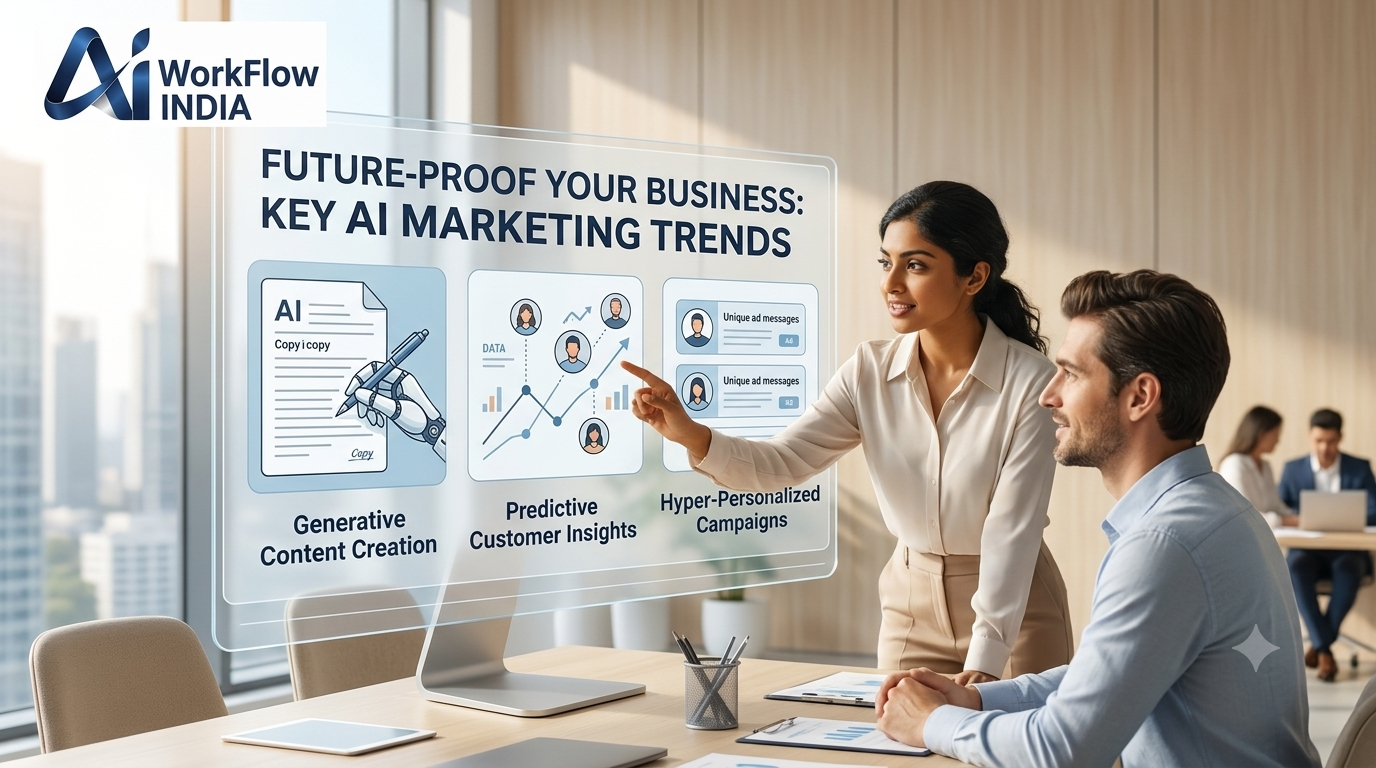
AI now enables hyper-personalization—creating unique experiences for each customer based on their browsing history, purchase behavior, location, and even the time of day they’re most active. Netflix recommendations and Spotify playlists are perfect examples of this in action.
For marketers, this means you can now deliver the right message to the right person at exactly the right moment. Email campaigns, website content, product recommendations—everything can be tailored to individual preferences automatically.
2. Predictive Analytics for Smarter Decisions
What if you could predict which leads are most likely to convert? Or know which customers are about to leave before they actually do?
Predictive analytics powered by AI makes this possible. By analyzing patterns in historical data, AI can forecast future customer behavior with impressive accuracy. This helps businesses:
- Focus sales efforts on high-value prospects
- Identify at-risk customers and re-engage them
- Optimize inventory based on predicted demand
- Plan marketing budgets more effectively
Companies using predictive analytics are seeing up to 73% higher sales than those who don’t. That’s a significant competitive advantage.
3. AI-Powered Content Creation
Content creation has always been time-consuming. Now, AI content tools are helping marketers produce blog posts, social media updates, ad copy, and even video scripts in a fraction of the time.
But here’s what’s important to understand: AI isn’t replacing human creativity. Instead, it’s handling the heavy lifting so marketers can focus on strategy and storytelling. The best results come from combining AI efficiency with human insight and emotional intelligence.
Smart businesses are already training their teams to work alongside these tools effectively. If you want your marketing department to stay ahead, consider investing in AI training for marketing teams to maximize the potential of these technologies.
4. Conversational AI and Chatbots
Customer expectations for instant responses have never been higher. AI chatbots and conversational marketing tools are meeting this demand by providing 24/7 support, answering questions, and even guiding customers through the purchase process.
Modern chatbots are far more sophisticated than their predecessors. They understand context, remember previous conversations, and can handle complex queries. Some can even detect customer emotions and adjust their responses accordingly.
The benefits are clear:
- Reduced customer service costs
- Faster response times
- Consistent brand messaging
- Valuable data collection from customer interactions
5. Voice Search Optimization
With smart speakers in millions of homes and voice assistants on every smartphone, voice search is changing how people find information online. By 2025, it’s estimated that over 50% of all searches will be voice-based.
This shift requires a new approach to SEO. Voice searches tend to be longer and more conversational than typed queries. Marketers need to optimize for natural language and question-based keywords to capture this growing traffic source.
How AI Is Transforming Different Marketing Channels
Let’s look at how artificial intelligence in digital marketing is impacting specific channels.
Email Marketing Gets Smarter
AI is revolutionizing email marketing in several ways:
- Send time optimization: AI determines when each subscriber is most likely to open emails
- Subject line testing: Machine learning predicts which subject lines will perform best
- Content personalization: Dynamic content blocks change based on recipient preferences
- List segmentation: AI automatically groups subscribers based on behavior patterns
The result? Higher open rates, better click-through rates, and improved conversions without additional manual effort.
Social Media Marketing Automation
Managing multiple social media platforms is exhausting. AI tools now help by:
- Suggesting optimal posting times
- Identifying trending topics relevant to your brand
- Analyzing sentiment in comments and mentions
- Generating content ideas based on audience interests
- Automating responses to common questions
This allows marketing teams to maintain an active social presence without burning out.
Paid Advertising Efficiency
AI-driven advertising platforms are getting better at optimizing ad spend. Google and Meta already use machine learning to improve ad targeting and bidding strategies. But newer tools go even further—creating ad variations, testing them automatically, and shifting budget to top performers in real-time.
Businesses using AI for paid advertising typically see 20-30% improvements in cost-per-acquisition. That’s money saved that can be reinvested into growth.
Getting Started with AI Marketing
Feeling overwhelmed? Don’t worry. You don’t need to implement everything at once. Here’s a practical approach to getting started:
Step 1: Assess your current marketing challenges. Where are you spending the most time? What’s not working as well as you’d like?
Step 2: Start with one tool or application. Maybe it’s an AI writing assistant, a chatbot, or a predictive analytics platform. Choose based on your biggest pain point.
Step 3: Train your team. Technology is only as good as the people using it. Ensure your marketing team understands how to leverage AI tools effectively.
Step 4: Measure and iterate. Track the results, learn from the data, and continuously improve your approach.
Remember, the goal isn’t to replace human marketers with robots. It’s to empower your team to do more impactful work by automating routine tasks and gaining deeper insights.
Common Mistakes to Avoid
As you embrace AI marketing strategies, watch out for these pitfalls:
- Over-relying on automation: AI should enhance human decision-making, not replace it entirely
- Ignoring data privacy: Always be transparent about how you collect and use customer data
- Expecting instant results: AI tools need time to learn and optimize
- Choosing tools without a strategy: Technology should serve your goals, not the other way around
The Future of AI in Marketing
Looking ahead, we can expect even more exciting developments. Generative AI will continue to improve, creating more realistic images, videos, and interactive content. Augmented reality experiences powered by AI will become mainstream in retail marketing. And real-time personalization will reach new levels of sophistication.
Businesses that start building their AI marketing capabilities today will be best positioned to take advantage of these advances. Those who wait risk being left behind as competitors move faster and smarter.
The time to act is now. Whether you’re just starting to explore AI marketing or looking to take your efforts to the next level, the opportunities are enormous. Start small, learn continuously, and don’t be afraid to experiment.
Your customers—and your bottom line—will thank you.
FAQs About AI Marketing
Is AI marketing suitable for small businesses?
Absolutely. Many AI marketing tools are now affordable and designed specifically for small businesses. You don’t need a huge budget to benefit from automation, better targeting, and data-driven insights. Start with free or low-cost tools and scale up as you see results.
Will AI replace human marketers?
No, AI won’t replace marketers—but marketers who use AI will replace those who don’t. AI handles repetitive tasks and data analysis, freeing humans to focus on creative strategy, emotional storytelling, and building genuine customer relationships. The best results come from human-AI collaboration.
How do I measure the success of AI marketing efforts?
Track the same metrics you would for any marketing initiative: conversion rates, customer acquisition costs, engagement rates, and ROI. Additionally, measure time saved on manual tasks and improvements in personalization effectiveness. Most AI tools provide built-in analytics to help you monitor performance.
“`
—
**For Rank Math Meta Post:**
**Title:** AI Marketing Trends Every Business Should Know in 2025
**Meta Description:** Discover the top AI marketing trends transforming business growth in 2025. Learn how to leverage artificial intelligence for smarter campaigns and better ROI.
**Meta Keywords:** AI marketing, artificial intelligence marketing, AI marketing trends, machine learning marketing, AI content tools, predictive analytics marketing, AI chatbots, digital marketing automation
Related resources
- Explore our AI Training for Marketing Teams.
- More guides in AI for Industries.