
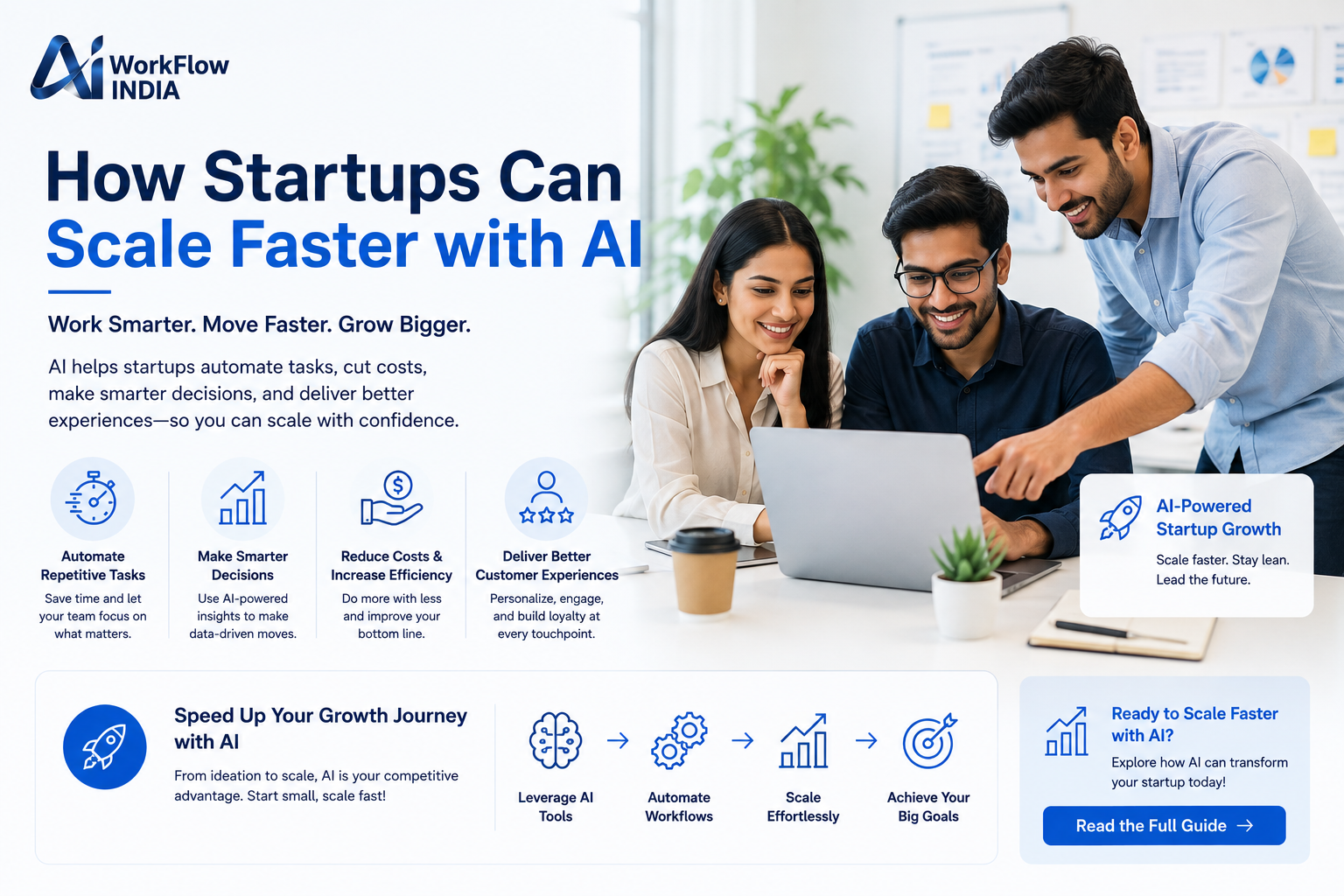
How Startups Can Scale Faster with AI

What if you could double your output without doubling your team? That’s not a fantasy anymore. It’s exactly what startup AI integration is making possible for ambitious founders right now.
The startup world moves fast. Really fast. And if you’re not keeping up, you’re falling behind. But here’s the exciting part: artificial intelligence has become the great equalizer. Small teams can now compete with industry giants by leveraging smart technology that works around the clock.
In this guide, we’ll explore practical ways your startup can use AI to accelerate growth, reduce costs, and build a sustainable competitive advantage. No hype. Just actionable strategies that work.
Why AI Matters More for Startups Than Big Corporations
Let’s get something straight. Large companies have resources, but they also have bureaucracy. They move slowly. Startups? You can pivot in a week. You can adopt new tools overnight. This agility is your superpower.
AI-powered tools amplify this advantage significantly. Here’s why:
- Lower operational costs – Automate repetitive tasks without hiring more staff
- Faster decision-making – Get insights from data in minutes, not months
- Better customer experiences – Personalize interactions at scale
- Reduced human error – Let machines handle precision-demanding work
A study by McKinsey found that companies adopting AI early see 20% higher cash flow. For startups watching every dollar, that difference matters enormously.
Key Areas Where Startups Can Leverage AI for Growth
Not sure where to start? You’re not alone. Many founders feel overwhelmed by the possibilities. Let’s break it down into manageable pieces.
Customer Support and Engagement
Your customers expect instant responses. They don’t care if you have a team of two or two hundred. AI chatbots and virtual assistants can handle 80% of routine inquiries automatically.
Tools like Intercom, Drift, and Zendesk use machine learning to understand customer questions and provide helpful answers. They learn from each interaction, getting smarter over time.
The result? Happy customers and a support team that focuses on complex issues that actually need human attention.
Marketing and Content Creation
Creating content consistently is tough when you’re running a business. AI writing assistants can help draft emails, social media posts, and even blog outlines. They won’t replace your unique voice, but they’ll give you a solid starting point.
More importantly, AI-driven analytics tools can tell you exactly what content resonates with your audience. No more guessing. You’ll know which topics drive traffic and which fall flat.
Sales and Lead Generation
Imagine knowing which leads are most likely to convert before your sales team even picks up the phone. Predictive AI makes this possible by analyzing patterns in your existing customer data.
These tools can score leads, recommend next actions, and even predict churn before it happens. Your team spends time on prospects who actually want to buy.
Product Development and Innovation
Building products that customers love requires understanding what they need. AI can analyze user behavior, feedback, and market trends to inform your roadmap.
Some startups use machine learning to run faster experiments. Instead of A/B testing two versions, they test dozens simultaneously and let algorithms find the winners.
Real-World Examples of Startups Winning with AI
Theory is great. But let’s look at companies actually doing this.
Grammarly started as a simple grammar checker. By investing heavily in natural language processing, they’ve become an essential writing tool worth over $13 billion. Their entire product is built on AI.
Notion recently integrated AI features that help users write, summarize, and brainstorm. This small addition dramatically increased user engagement and attracted new customers who wanted smart productivity tools.
Lemonade, the insurance startup, uses AI to process claims in seconds. What takes traditional insurers weeks, they accomplish before you finish your coffee. That speed became their primary selling point.
These companies didn’t wait until they were big to embrace artificial intelligence. They built it into their DNA from the start.
How to Get Started with AI at Your Startup
Ready to take action? Here’s a practical roadmap that won’t overwhelm your team or budget.
Step 1: Identify Your Biggest Time Drains
Where does your team spend hours on repetitive work? Customer emails? Data entry? Report generation? These are your first automation targets.
Make a list. Rank them by impact and frequency. Start with the task that eats the most time.
Step 2: Choose the Right Tools
You don’t need to build AI from scratch. Hundreds of ready-made solutions exist for startups at every stage. Some popular options include:
- ChatGPT and Claude – General-purpose assistants for writing and analysis
- Jasper – Marketing-focused content creation
- HubSpot – AI-enhanced CRM and marketing automation
- Fireflies.ai – Meeting transcription and insights
Most offer free trials. Test before you commit.
Step 3: Train Your Team
Tools are only as good as the people using them. Invest time in proper training. When your team understands how to prompt AI effectively, they’ll get dramatically better results.
Consider structured learning opportunities. Many organizations offer specialized AI training for startups that covers practical applications, prompt engineering, and implementation strategies tailored to small teams.
Step 4: Measure and Iterate
Track everything. How much time did you save? Did quality improve? Are customers happier?
AI implementation isn’t a one-time project. It’s an ongoing process of testing, learning, and optimizing.
Common Mistakes Startups Make with AI Adoption
Let’s be honest. Not every AI initiative succeeds. Here are pitfalls to avoid:
Trying to automate everything at once. Start small. Prove value in one area before expanding. Trying to transform your entire operation overnight leads to chaos.
Ignoring data quality. AI is only as good as the data you feed it. Garbage in, garbage out. Clean your data before expecting magical results.
Forgetting the human element. Customers still want human connection for complex issues. Use AI to enhance human interactions, not replace them entirely.
Skipping security considerations. When you feed business data into AI tools, understand where that data goes. Choose providers with strong privacy policies and compliance certifications.
The Future of AI-Powered Startups
We’re still in the early innings of this transformation. What’s possible today will seem basic in five years.
Voice AI is becoming sophisticated enough to handle complex phone conversations. Computer vision enables startups in retail, healthcare, and manufacturing to see patterns humans miss. Generative AI creates everything from code to designs to business strategies.
Startups that build AI fluency now will have tremendous advantages. Those that wait risk becoming irrelevant.
The question isn’t whether to adopt artificial intelligence. It’s how quickly you can integrate it into your operations effectively.
Taking Your First Step Today
Scaling a startup has never been easy. But it’s never been more possible either. AI gives small teams superpowers that were unimaginable just a few years ago.
Pick one area of your business. Choose one tool. Run one experiment this week. The journey of a thousand miles starts with a single step, and your AI journey starts with a single implementation.
Your competitors are already moving. The startups that will dominate the next decade are building their AI capabilities right now. Will yours be one of them?
Frequently Asked Questions
How much does it cost to implement AI in a startup?
Many AI tools offer free tiers or affordable monthly subscriptions starting at $20-50 per month. You can begin experimenting without significant investment. As your needs grow, enterprise solutions typically range from $500-5000 monthly depending on features and usage.
Do I need technical expertise to use AI tools?
Not necessarily. Most modern AI platforms are designed for non-technical users. Basic tools like ChatGPT or Jasper require no coding knowledge. However, understanding how to write effective prompts and interpret results will improve your outcomes significantly.
How long does it take to see results from AI implementation?
Some benefits appear immediately. Automating customer support can save hours in your first week. More complex implementations like predictive analytics may take 2-3 months to show meaningful impact as the system learns from your data.
“`
—
**For Rank Math Meta Post:**
**Title:** How Startups Can Scale Faster with AI | Growth Strategies
**Meta Description:** Discover how startup AI integration accelerates growth, reduces costs, and builds competitive advantage. Practical strategies for founders ready to scale.
**Meta Keywords:** startup AI, AI for startups, startup growth strategies, artificial intelligence startups, AI tools for small business, startup automation, scaling with AI
Related resources
- Explore our AI Training for Startups.
- More guides in AI Adoption for Organizations.