
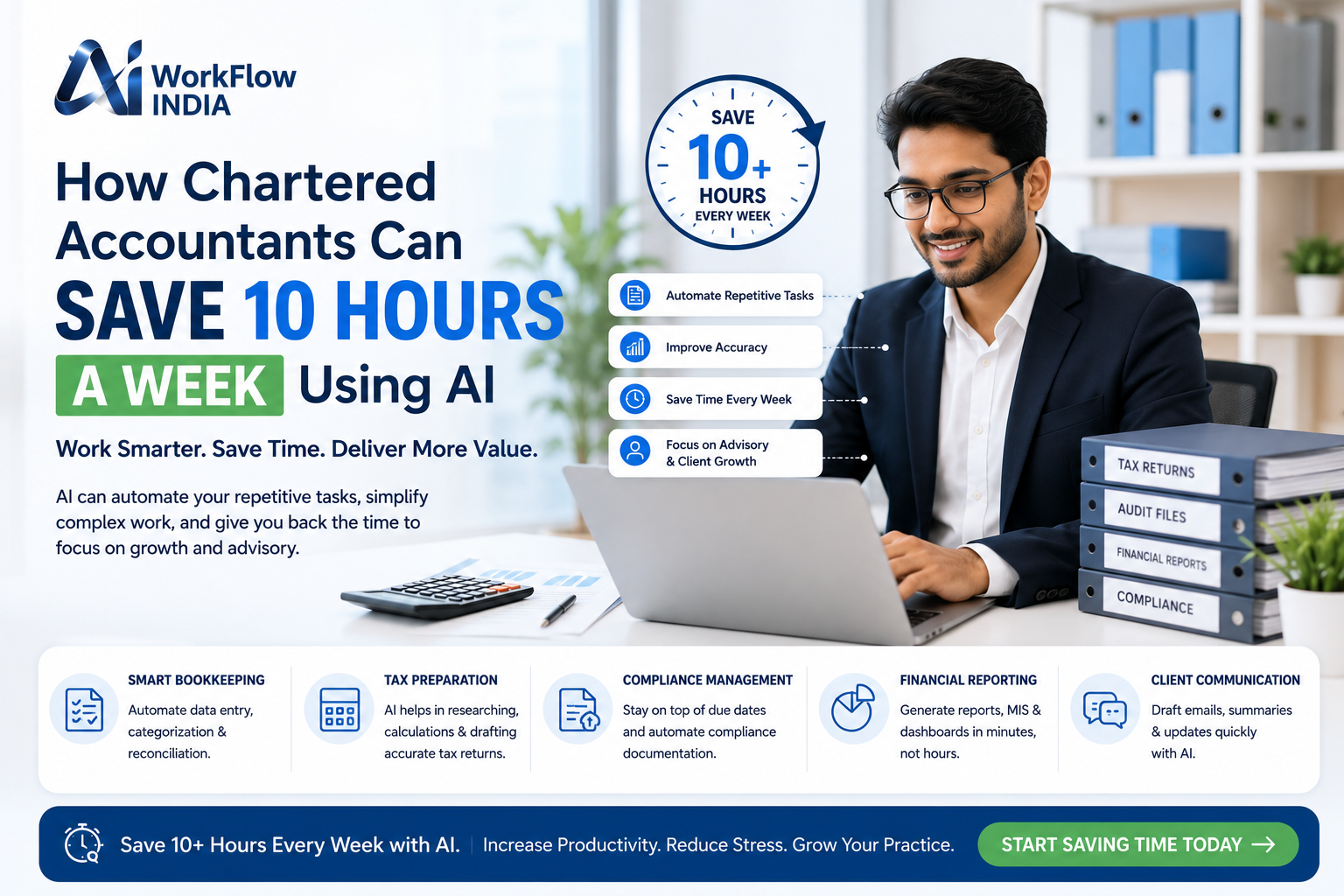
How Chartered Accountants Can Save 10 Hours a Week Using AI

How Chartered Accountants Can Save 10 Hours a Week Using AI
What would you do with an extra 10 hours every week? That’s not a hypothetical question anymore. AI for CAs is changing how chartered accountants work, and the results are nothing short of remarkable.
If you’re still spending countless hours on data entry, reconciliations, and repetitive tasks, you’re working harder than you need to. The truth is, accounting AI tools can handle much of the heavy lifting while you focus on what actually matters—advising clients and growing your practice.
Let’s explore exactly how artificial intelligence can give you back those precious hours each week.
Why Chartered Accountants Are Turning to AI Solutions
The accounting profession is evolving faster than ever before. Clients expect quicker turnarounds. Regulations keep changing. Competition is fierce. Meanwhile, you’re drowning in spreadsheets and manual processes.
Here’s the reality: traditional accounting methods simply can’t keep up anymore.
AI-powered accounting tools offer a practical solution. They don’t replace your expertise. Instead, they amplify it. Think of AI as your tireless assistant that never calls in sick, never makes calculation errors, and works around the clock.
Consider these common time drains in a typical CA’s week:
- Manual data entry from invoices and receipts
- Bank reconciliation across multiple accounts
- Generating routine financial reports
- Chasing clients for missing documents
- Reviewing transactions for anomalies
Each of these tasks can be streamlined or automated with the right AI tools for accountants. The time savings add up quickly.
Five Ways AI for CAs Delivers Real Time Savings
1. Automated Data Entry and Document Processing
How many hours do you spend manually entering invoice data? For most chartered accountants, this tedious task eats up 5-8 hours weekly.
Intelligent document processing uses optical character recognition (OCR) combined with machine learning. These systems can extract data from invoices, receipts, and financial documents automatically. They learn your preferences over time and become more accurate with each use.
The result? What once took hours now happens in minutes. Your staff can review the extracted data rather than type it in manually.
2. Smart Bank Reconciliation
Bank reconciliation is essential but incredibly time-consuming. Matching thousands of transactions across multiple accounts can take days each month.
AI-driven reconciliation tools can match transactions automatically with over 95% accuracy. They flag discrepancies for your review instead of making you hunt for them. This alone can save 2-3 hours per week for a typical practice.
3. Automated Report Generation
Clients need regular financial reports. Creating these reports manually involves pulling data from various sources, formatting spreadsheets, and ensuring accuracy.
With accounting AI solutions, you can generate comprehensive reports with a few clicks. These tools pull data automatically, apply your preferred formatting, and even highlight key insights for client meetings.
4. Intelligent Client Communication
How much time do you spend sending reminder emails for missing documents? Following up on outstanding queries? Scheduling appointments?
AI-powered automation handles routine client communications efficiently. Automated reminders go out on schedule. Document requests include clear instructions. Clients get instant responses to common questions through smart chatbots.
This frees you to have meaningful conversations instead of sending administrative emails.
5. Predictive Analytics and Anomaly Detection
Reviewing financial data for errors or unusual patterns requires careful attention. It’s mentally exhausting work that takes considerable time.
Machine learning algorithms excel at pattern recognition. They can scan thousands of transactions and immediately flag anything unusual. This means you spend time investigating actual issues rather than searching for needles in haystacks.
Getting Started with AI in Your Accounting Practice
Implementing AI doesn’t mean overhauling your entire practice overnight. The smartest approach is starting small and building momentum.
Begin by identifying your biggest time drains. Where do you and your team spend the most hours on repetitive work? That’s your starting point for automation.
Next, research tools specifically designed for accounting professionals. Generic AI solutions often miss the mark. You need software that understands accounting workflows, compliance requirements, and client expectations.
Training is crucial for success. Even the best AI tools for CAs won’t help if your team doesn’t know how to use them effectively. Consider investing in proper AI training for chartered accountants to ensure you’re maximizing the technology’s potential.
Finally, measure your results. Track how much time you’re actually saving. This data helps justify further investments and identifies areas for improvement.
Common Concerns About AI in Accounting
Many chartered accountants hesitate to adopt AI. Let’s address the most common concerns.
Will AI Replace My Job?
This fear is understandable but largely unfounded. AI for CAs handles routine tasks, but it cannot replicate human judgment, client relationships, or strategic thinking. The accountants who thrive will be those who leverage AI to deliver more value, not those who compete against it.
Is AI Accurate Enough for Financial Work?
Modern accounting AI systems achieve impressive accuracy rates, often exceeding 95% for standard tasks. However, they work best as tools that assist human professionals rather than completely autonomous systems. You remain in control, reviewing and approving AI-generated work.
What About Data Security?
Reputable AI accounting platforms take security seriously. Look for solutions with strong encryption, compliance certifications, and clear data handling policies. Your clients’ financial information deserves robust protection.
Real Results from AI-Powered Accounting Practices
The numbers don’t lie. Firms that have embraced artificial intelligence in accounting report significant improvements across key metrics.
Average time savings range from 8-12 hours per week per accountant. Error rates drop dramatically. Client satisfaction improves because turnaround times decrease.
One mid-sized firm reported cutting their month-end close process from five days to two days after implementing AI tools. Another solo practitioner doubled their client base without hiring additional staff.
These aren’t exceptional cases. They’re becoming the new normal for forward-thinking accounting professionals.
Building Your AI Adoption Roadmap
Ready to reclaim those 10 hours each week? Here’s a practical roadmap to get started.
Month One: Audit your current processes. Document where time goes. Identify automation opportunities.
Month Two: Research and select one AI tool that addresses your biggest pain point. Start with a focused solution rather than trying to automate everything at once.
Month Three: Implement your chosen tool. Invest in proper training. Track time savings and results.
Month Four and Beyond: Expand your AI toolkit based on initial results. Continue learning about new AI solutions for accountants as technology evolves.
The key is consistent progress rather than perfection. Each small improvement compounds over time.
The Future Belongs to AI-Enabled Chartered Accountants
The accounting profession stands at a crossroads. Those who embrace AI for CAs will work smarter, serve clients better, and enjoy more fulfilling careers. Those who resist will find themselves struggling to compete.
The good news is that getting started isn’t as difficult as it might seem. With the right tools, proper training programs designed for chartered accountants, and a willingness to adapt, you can transform your practice.
Those 10 hours you save each week? Spend them on high-value advisory work. Use them to grow your client base. Or simply enjoy a better work-life balance.
The technology exists. The opportunity is here. The only question is whether you’ll seize it.
Take the first step today. Explore how accounting AI can work for your practice. Your future self will thank you for starting now.
Frequently Asked Questions
How much do AI accounting tools typically cost?
AI accounting software varies widely in pricing, from free basic tools to enterprise solutions costing several hundred dollars monthly. Most small to mid-sized practices find effective options in the $50-200 per month range. The key is calculating your return on investment based on time saved and increased capacity.
Can AI tools integrate with my existing accounting software?
Most modern AI for CAs solutions offer integrations with popular accounting platforms like Tally, QuickBooks, Xero, and Zoho Books. Before selecting any tool, verify compatibility with your current tech stack. Good integration means smoother workflows and faster adoption.
How long does it take to see results from implementing AI in my practice?
Many chartered accountants report noticeable time savings within the first two weeks of implementation. However, full benefits typically emerge after 2-3 months as you and your team become comfortable with new workflows. Patience during the learning curve pays off with significant long-term gains.
“`
—
**For Rank Math Meta Post:**
**Title:** How Chartered Accountants Can Save 10 Hours a Week Using AI
**Meta Description:** Discover how AI for CAs can save 10+ hours weekly. Learn practical accounting AI strategies to automate tasks and grow your practice efficiently.
**Meta Keywords:** AI for CAs, accounting AI, AI tools for accountants, artificial intelligence in accounting, AI solutions for chartered accountants
Related resources
- Explore our AI Training for Chartered Accountants.
- More guides in AI for Industries.



Comments