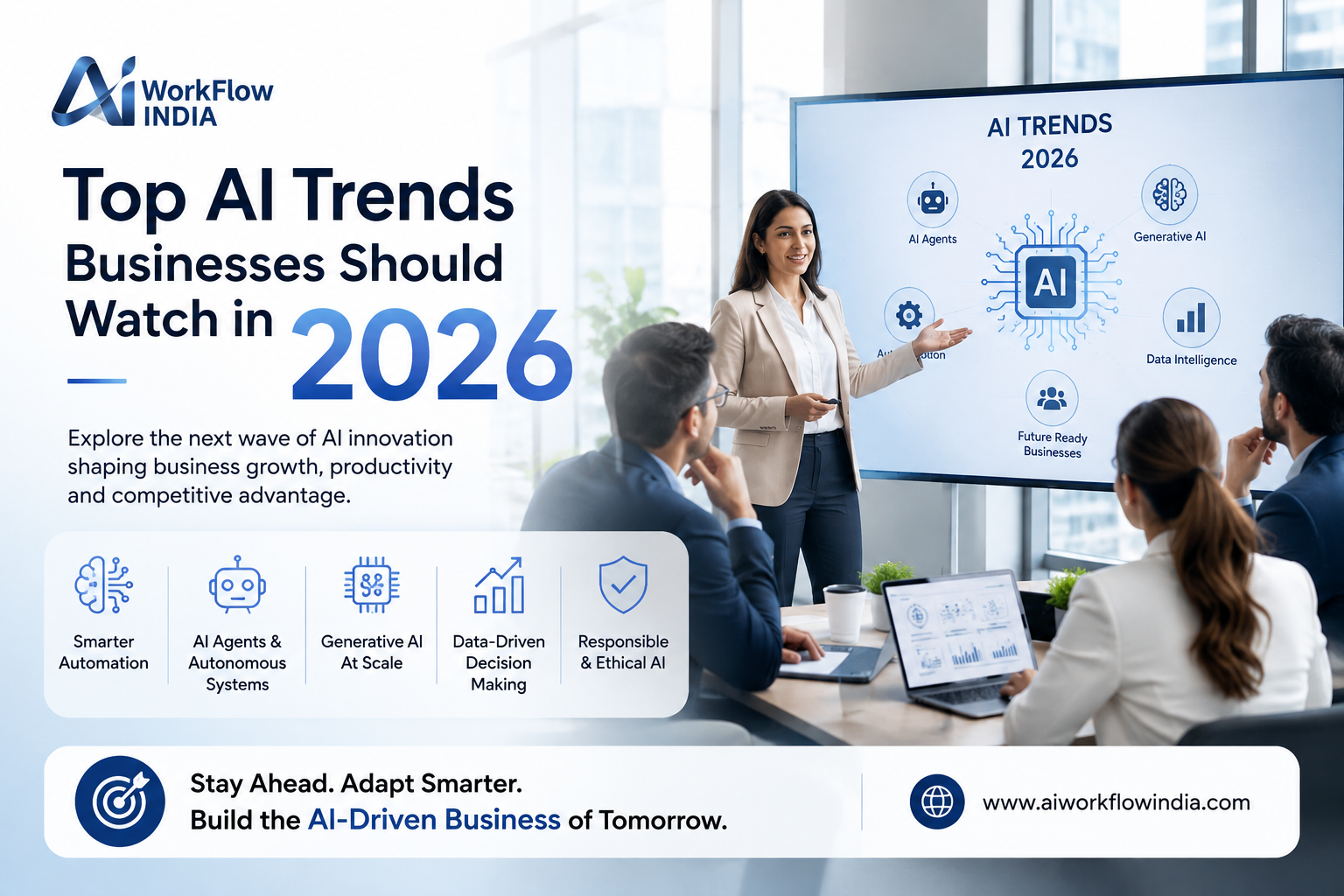
Top AI Trends Businesses Should Watch in 2026

Artificial intelligence is no longer a futuristic concept. It’s happening right now, and it’s changing how businesses operate every single day. If you’re not paying attention to the latest AI trends business leaders are embracing, you might find yourself falling behind your competitors.
The year 2026 is shaping up to be a game-changer. From smarter automation tools to AI systems that can think more like humans, the opportunities are endless. But here’s the thing—not every trend will matter to your business. That’s why we’ve put together this guide to help you focus on what truly counts.
Let’s dive into the AI trends that will shape the business landscape in 2026 and beyond.
Generative AI Gets Smarter and More Practical
You’ve probably heard about ChatGPT and similar tools. But in 2026, generative AI is moving far beyond simple chatbots. These systems are becoming true business partners.
Companies are now using generative artificial intelligence to:
- Create marketing content in seconds
- Design product prototypes without human designers
- Write code and debug software automatically
- Generate financial reports and analysis
What makes this exciting is the level of customization available. Businesses can train these AI models on their own data. This means the content and solutions they produce feel authentic to your brand voice.
Small businesses especially benefit from this shift. Tasks that once required expensive agencies can now be handled in-house with AI assistance. The cost savings are significant, and the quality keeps improving.
AI-Powered Decision Making Becomes Standard
Making decisions based on gut feelings is becoming a thing of the past. In 2026, AI-driven decision-making tools are helping business leaders see patterns they never could before.
Think about it this way. Your brain can process a limited amount of data. An AI system can analyze millions of data points in seconds. It can spot trends, predict outcomes, and recommend actions based on hard evidence.
Industries seeing the biggest impact include:
- Retail: Predicting inventory needs before shortages happen
- Healthcare: Identifying treatment options based on patient history
- Finance: Detecting fraud before money leaves accounts
- Manufacturing: Scheduling maintenance before equipment fails
The key advantage here is speed. While your competitors are still gathering data, you’re already acting on insights. That’s a competitive edge that’s hard to beat.
Hyper-Personalization Transforms Customer Experience
Customers today expect businesses to know them. Generic marketing messages don’t cut it anymore. This is where AI personalization steps in as a critical business tool.
In 2026, AI systems can create unique experiences for each customer. We’re not just talking about using someone’s first name in an email. We’re talking about:
- Product recommendations based on browsing behavior and purchase history
- Dynamic pricing that adjusts to individual customer value
- Content that changes based on user preferences
- Customer service responses tailored to past interactions
Netflix and Amazon pioneered this approach. Now, businesses of all sizes can access similar technology. The result? Higher conversion rates, better customer retention, and increased revenue.
AI Agents Take Over Routine Tasks
Here’s one of the most transformative AI trends business owners need to understand. AI agents are essentially digital workers that can handle complex tasks independently.
Unlike simple automation that follows rigid rules, AI agents can:
- Understand context and make judgment calls
- Learn from mistakes and improve over time
- Communicate with other AI systems to complete multi-step projects
- Adapt to new situations without reprogramming
Imagine having an AI agent that handles your entire customer onboarding process. It sends welcome emails, schedules training calls, answers questions, and flags issues for human review. All without constant supervision.
This frees up your human team to focus on creative and strategic work. The tasks that actually require human touch get more attention, while routine work runs on autopilot.
The Rise of Multimodal AI Systems
Early AI tools were specialists. One could write text. Another could recognize images. A third could process voice commands. But they couldn’t work together seamlessly.
Multimodal AI changes everything. These systems can understand and generate multiple types of content simultaneously. You can show an AI a photo and ask questions about it. You can describe a scene with words and get a video in return.
For businesses, this opens up incredible possibilities:
- Customer service bots that can see and discuss product images
- Training materials that combine text, video, and interactive elements
- Quality control systems that use visual inspection and data analysis together
- Marketing campaigns that automatically adapt across different media formats
Companies that want to stay competitive should consider investing in corporate AI training to help their teams understand and leverage these powerful multimodal tools effectively.
Edge AI Brings Intelligence to Devices
Not all AI needs to live in the cloud. Edge AI puts intelligence directly into devices like phones, cameras, and sensors. This matters more than you might think.
When AI runs locally on a device, several things happen:
- Response times become nearly instant
- Privacy improves because data stays on the device
- Systems keep working even without internet connection
- Bandwidth costs drop dramatically
Manufacturing plants use edge AI to monitor equipment in real-time. Retail stores use it for instant inventory tracking. Healthcare providers use it for patient monitoring that never misses a beat.
As devices become more powerful, expect edge AI to handle increasingly complex tasks. This is one of the business technology trends that will reshape entire industries.
AI Ethics and Governance Take Center Stage
With great power comes great responsibility. As AI becomes more capable, questions about ethics and governance become impossible to ignore.
In 2026, businesses face growing pressure to:
- Explain how their AI systems make decisions
- Prove their AI doesn’t discriminate against protected groups
- Protect customer data used to train AI models
- Take responsibility when AI makes mistakes
Governments worldwide are passing new regulations. The European Union’s AI Act sets strict rules for high-risk AI applications. Other regions are following suit with their own frameworks.
Smart businesses aren’t waiting for regulations to force their hand. They’re building ethical AI practices now. This protects them legally and builds trust with customers who care about responsible technology use.
Collaborative AI Enhances Human Workers
There’s a common fear that AI will replace human workers. The reality in 2026 looks different. The most successful companies use AI collaboration to make their employees more effective.
Think of AI as a powerful tool, not a replacement. A carpenter with power tools can build faster than one with only hand tools. Similarly, a worker with AI assistance can accomplish more than one without it.
Examples of effective human-AI collaboration include:
- Doctors using AI to analyze scans while making final diagnoses themselves
- Writers using AI for research and first drafts while adding creativity and voice
- Analysts using AI to crunch numbers while providing strategic interpretation
- Designers using AI for initial concepts while refining and perfecting the work
The businesses that thrive will be those that find the right balance. They’ll use AI to handle the tasks it does best while empowering humans to do what they do best.
Preparing Your Business for the AI-Powered Future
Understanding these AI trends is only the first step. The real challenge is putting them into action. Here’s how forward-thinking businesses are preparing:
Start with clear business problems. Don’t adopt AI just because it’s trendy. Identify specific challenges where AI can make a measurable difference.
Invest in your people. Technology is only as good as the people using it. Training your team on artificial intelligence applications ensures you get real value from your investment.
Build quality data foundations. AI systems need good data to produce good results. Clean, organized, and accessible data is essential.
Start small and scale. Pilot projects let you learn what works before making major commitments. Success in small projects builds confidence for larger ones.
Stay flexible. The AI landscape changes rapidly. What works today might not work tomorrow. Build systems that can adapt as technology evolves.
The businesses that embrace these changes thoughtfully will find themselves well-positioned for success. Those that ignore them risk being left behind by more innovative competitors.
The future belongs to companies that see AI not as a threat, but as an opportunity. Which type of company will yours be?
FAQs About AI Trends for Businesses
What is the most important AI trend for small businesses in 2026?
For small businesses, generative AI tools offer the biggest immediate value. These tools can handle content creation, customer service, and administrative tasks at a fraction of the cost of hiring additional staff. They level the playing field against larger competitors.
How can businesses prepare their employees for AI changes?
The best approach combines formal training with hands-on experience. Start by identifying which roles will be most affected by AI. Then provide targeted education on relevant tools and techniques. Encourage experimentation and create safe spaces for learning.
Will AI replace human workers in most businesses by 2026?
Complete replacement is unlikely for most roles. Instead, expect to see AI augmenting human capabilities. Workers who learn to use AI tools effectively will become more valuable, not less. Jobs will evolve rather than disappear entirely.
“`
—
**For Rank Math Meta Post:**
**Title:** Top AI Trends Businesses Should Watch in 2026 | Must-Know Insights
**Meta Description:** Discover the top AI trends businesses should watch in 2026. Learn how artificial intelligence is reshaping industries and what your company needs to know.
**Meta Keywords:** AI trends business, artificial intelligence trends, AI business trends 2026, AI technology for business, business AI adoption, enterprise AI trends